Is Cyprus Missing the MiCA Train? Cross-Border Dominance, CFDs, and the CASP Authorisation Gap
Note: The MiCA authorisation data in this article reflects a snapshot of ESMA's public register dated 29 May 2026. The register is updated on a rolling basis. The cross-border investment services data is drawn from ESMA's annual report published in December 2025, covering the 2024 reporting year.
1. Cyprus and Cross-Border Investment Services
In December 2025, the European Securities and Markets Authority published its annual report on the cross-border provision of investment services to retail clients in the EU and EEA. The data covers the 2024 reporting year.
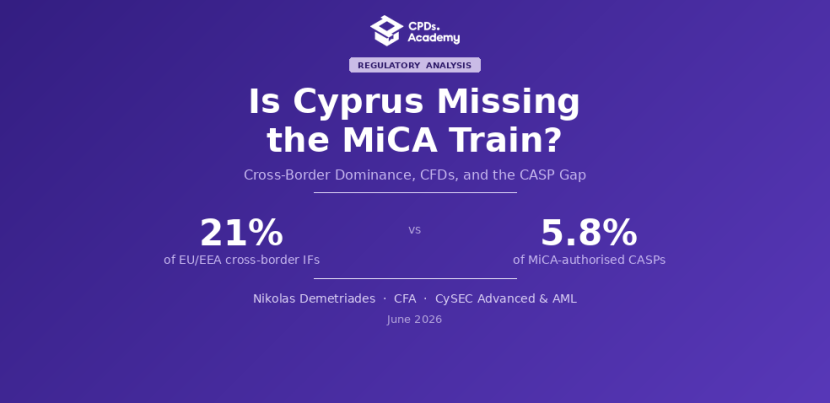
The headline figures for Cyprus are striking. Out of 370 firms providing cross-border investment services across 30 EU/EEA countries, 79 are based in Cyprus. That is 21% of the total. Luxembourg follows with 55 firms. Germany is third with 47.
The client numbers tell a sharper story. Cyprus-based firms served 3.6 million cross-border retail clients in 2024, up from 3.4 million the year before. That is 34% of every retail client receiving cross-border investment services in the EU/EEA. One in three.
Two of the five largest firms by cross-border retail client volume are based in Cyprus. Some firms based in Cyprus reported providing services to retail clients in all 29 other EU/EEA Member States.
Cyprus is also home to the largest number of investment firms (as distinct from credit institutions) providing cross-border services: 77 out of 217 investment firms across the EU/EEA, or 35% of the total.
No other jurisdiction comes close to that combination of firm concentration and client reach.
2. The Product Dimension
The ESMA report tracks complaints filed by cross-border retail clients and breaks them down by product type. For Cyprus-based firms, the product distribution is revealing.
Of the complaints that could be attributed to a specific financial product, 530 out of 672 related to CFDs. That is 79%.
The ESMA complaints data does not prove, by itself, that Cyprus's cross-border dominance was built on CFDs. But it reflects something anyone in the Cyprus financial services sector will recognise: CFDs and leveraged retail products have been central to the island's cross-border investment services model.
Much of the local cross-border investment services ecosystem, from compliance expertise to operational infrastructure and talent, developed around leveraged retail products, especially CFDs and forex. That is not a criticism of the model. It is a description of the market as it developed.
What this means in practice: Cyprus's cross-border position did not emerge by accident. Firms, clients, supervisors and compliance professionals built around a passportable model that Cyprus understood well. The regulatory infrastructure, the professional community, and the commercial ecosystem all grew together around this model over more than a decade.
3. MiCA and the New Landscape
The Markets in Crypto-Assets Regulation entered into full application on 30 December 2024. Under MiCA, firms wishing to provide crypto-asset services in the EU must operate under the relevant MiCA route. For most standalone crypto-asset service providers, that means authorisation as a Crypto-Asset Service Provider (CASP) from the national competent authority. Certain financial entities, including credit institutions and investment firms, may instead rely on the Article 60 notification route for eligible crypto-asset services. Once the relevant MiCA route is in place, the model is passportable across the EU.
The structure is familiar: one home-state regulatory route, with the ability to provide services across Member States once the relevant MiCA requirements are met. It is, in many respects, the same passporting model that underpins the cross-border investment services market that Cyprus leads.
Existing crypto-asset service providers that were operating under national frameworks before December 2024 may benefit from a transitional period that runs until 1 July 2026, unless authorisation is granted or refused earlier. After that date, firms will need to operate under the applicable MiCA route, whether through CASP authorisation or, where available, the Article 60 notification route for eligible financial entities.
The question is: where are firms choosing to get authorised?
4. The ESMA MiCA Register: A Snapshot
ESMA maintains a public register of all CASPs authorised under MiCA. As of the 29 May 2026 snapshot, the register listed 208 authorised CASPs across 23 EU/EEA countries. The register is updated on a rolling basis, so these figures represent a snapshot rather than a fixed total.
The distribution at the snapshot date was as follows:
Germany: 55 · Netherlands: 26 · France: 19 · Malta: 13 · Cyprus: 12 · Ireland: 12 · Austria: 9 · Czech Republic: 7 · Spain: 7 · Luxembourg: 7 · Lithuania: 6 · Slovakia: 6 · Finland: 5 · Liechtenstein: 5 · Denmark: 4 · Latvia: 4 · Slovenia: 3 · Bulgaria: 2 · Croatia: 2 · Belgium: 1 · Estonia: 1 · Italy: 1 · Sweden: 1
Germany alone accounted for 55 authorised CASPs, more than four times Cyprus. The Netherlands had 26. France, which had considerably fewer CASPs earlier in the year, had grown rapidly to 19.
Cyprus had 12, representing 5.8% of the EU/EEA total. It was tied fifth with Ireland.
Compare that to cross-border investment services, where Cyprus holds 21% of firms and 34% of clients. The dominance does not carry over automatically.
5. What the Cyprus CASP List Tells Us
The twelve CASPs authorised through CySEC as of the snapshot date are: eToro (among the early Cypriot MiCA authorisations in 2025),Collect & Exchange, Trading 212, Stratos Europe (Tradu),Revolut, Teroxx Digital Asset, Capital.com, Pelican Exchange Europe, XTB Limited, Noemon Finance, Trading.com, and J2TX.
Several of these are names that compliance professionals in Cyprus will recognise immediately. eToro, Trading 212, Capital.com, XTB, and Trading.com are established investment firms that have operated in Cyprus for years and added crypto-asset services under MiCA. Revolut chose its Cyprus entity for its MiCA authorisation, passporting across the EU from Limassol.
Several of the Cyprus names already had a Cyprus presence before MiCA. That suggests Cyprus is, at least so far, retaining part of its existing financial services base rather than clearly emerging as the first-choice MiCA hub for new crypto-native entrants.
Germany, Malta, the Netherlands and Luxembourg appear to be building that position more quickly, at least on the current snapshot. Major exchanges, custodians and crypto-native platforms have clustered in those jurisdictions in the early phase of MiCA implementation.
The distinction matters. Retaining existing firms is valuable, but attracting new firms choosing a MiCA home for the first time is a different competitive question.
6. The Stablecoin Gap
MiCA does not only cover crypto-asset service providers. It also establishes a framework for the issuance of asset-referenced tokens (ARTs) and e-money tokens (EMTs),the category that includes many stablecoins.
As of the 29 May 2026 snapshot, ESMA's register listed 39 e-money token white papers filed across 12 EU/EEA countries. The Netherlands led with 9. France had 7. Finland had 4. Malta had 4. Germany had 3.
Cyprus had zero.
No asset-referenced tokens had been registered anywhere in the EU/EEA at the snapshot date.
The absence of Cyprus from the EMT register adds another dimension to the picture. Stablecoins are becoming an increasingly important part of the crypto-asset infrastructure. The jurisdictions that host EMT issuers are likely to attract the wider ecosystem that forms around them: custody providers, exchanges, payment processors. Cyprus is not yet part of that ecosystem under MiCA.
7. Two Possible Directions
Cyprus became a major EU/EEA cross-border investment services jurisdiction because firms, clients, supervisors and compliance professionals built around a passportable model that Cyprus understood well.
MiCA creates another passportable model. A single authorisation or notification framework for crypto-asset services, usable across the EU/EEA once the relevant MiCA route is in place. The countries that process authorisations efficiently and set clear expectations are likely to have an early advantage in shaping the market.
From here, there are broadly two directions.
Direction one: Cyprus competes actively. CySEC processes MiCA authorisations efficiently, builds a clear supervisory approach to crypto-asset services, and attracts new crypto-native firms alongside its existing base. Cyprus extends its cross-border position into digital asset services.
Direction two: MiCA remains an adjacent licence category. The firms that obtain MiCA authorisation through CySEC are predominantly those already licensed in Cyprus for other reasons. The crypto-native firms, exchanges, and stablecoin issuers continue to cluster in Germany, the Netherlands, Malta, and Luxembourg. Other jurisdictions close the gap on Cyprus in overall cross-border market share as crypto services become a larger part of the retail investment landscape.
Both directions have real implications for compliance professionals in Cyprus. If the first scenario plays out, the demand for professionals with crypto-asset compliance expertise will grow significantly. If the second plays out, that demand will materialise more strongly in Frankfurt, Amsterdam, Valletta, and Dublin.
What this means in practice: The MiCA transitional period runs until 1 July 2026 for relevant firms unless authorisation is granted or refused earlier. The numbers in the ESMA register will continue to change. But the early pattern is worth watching. The question is whether Cyprus will treat MiCA as an adjacent licence category for firms already here, or as a chance to compete for the next wave of EU/EEA digital-asset business.
8. Sources
ESMA, Report on the 2024 Cross-border Provision of Investment Services to Retail Clients in the EU and EEA, 22 December 2025. Available at: esma.europa.eu
ESMA MiCA Register, Authorised Crypto-Asset Service Providers (interim register, updated on a rolling basis). Snapshot dated 29 May 2026. Available at: esma.europa.eu
ESMA MiCA Register, E-Money Token White Papers. Snapshot dated 29 May 2026. Available at the same ESMA MiCA page.
Know what is coming before it arrives. Our seminars cover the regulatory frameworks shaping how investment firms and crypto-asset service providers operate across the EU.
Explore seminars at cpds.academy

Article by Nikolas Demetriades
Published 02 Jun 2026